Congressman Kevin McCarthy of California's 22nd District plans to introduce the "Wilderness and Roadless Area Release Act¹” in the near future. The purpose of this legislation is to "release all Wilderness Study Areas and Inventoried Roadless Areas, which have been recommended as not suitable for wilderness by the Bureau of Land Management or the United State(s) Forest Service, and direct that they be managed for multiple use.²" The effect, if this bill becomes law, would be to open more land for prospecting and mining as well as for other public uses.
At present, advocates of this bill are requesting that organizations (not individuals) send an email to Ben McFarland at Congressman McCarthy's office (benjamin.mcfarland@mail.house.gov) asking him to add the organization's name to the list of supporters and to also ask their Congressperson to co-sponsor this legislation. After contacting their Congressperson's office, they can download and send them this "Dear Colleague" letter.
More documentation in .pdf format regarding this bill:
Overview of the bill
Text of the bill
More information as it becomes available.
¹ Forwarded email from Chris Horgan at "Save the Trails"
² Ibid.
Thursday, March 31, 2011


House Committee to Hear Presentation on Beach Mining Pilot Program
The latest development in the long-in-coming opportunity to mine gold at Washington's ocean beaches will be on April 8 before the House Agriculture & Natural Resources Committee. According to the current agenda, this work session will include a "(j)oint presentation by the Department of Fish and Wildlife and the Parks and Recreation Commission on the findings of the Small Scale Mining and Prospecting on Ocean Beaches Pilot Program." As this meeting is not open for public testimony, I mention it here for information only.
For some background on the "Beach Mining Pilot Program," see my earlier posts here, here, and here.
Washington State Miner will continue to follow and report on this story.
For some background on the "Beach Mining Pilot Program," see my earlier posts here, here, and here.
Washington State Miner will continue to follow and report on this story.
Monday, March 21, 2011
MineCache: A Google Earth Plug-in For Gold Prospectors
MineCache is a free plug-in for Google Earth that displays a wealth of information regarding locations where gold has been found in the past. That is to say, those locations where gold is most likely to be found in the present. MineCache displays gold deposit information for the entire United States, including Alaska.
The first step in getting MineCache running on your computer is to download and install Google Earth, which may be done by visiting the link in the first paragraph above and following the on-screen directions.
The next step is to download the MineCache.kml plug-in from the MineCache website linked at the start of this post. With Google Earth running on your computer, visit the download link at MineCache.com and, after registering, follow the instructions there. The MineCache folder will appear in the "Temporary Places" folder in the "Places" section of the left-hand sidebar. (When you exit Google Earth, you will be told you have unsaved items in the "Temporary Places" folder. If you want to keep the MineCache plug-in, click "Save.")
Here is a picture of my "Places" sidebar after installing MineCache (and saving it):

As you may notice, MineCache opens with the options "Auto Refresh," "All Gold Claims - MRDS," and "Zoom in closer" checked.
"Auto Refresh" means that as you move the view-port in Google Earth to a new location, after a second or two the display of gold claims will refresh. If you don't want that to happen by itself, select "Manual Refresh" lower in the list.
"All Gold Claims - MRDS" means that the data displayed is from the USGS Mineral Resource Data System; the same data source discussed in my previous articles on "Armchair Prospecting." In the case of MineCache, the data is pre-selected to show gold deposits only.
"Zoom in closer" means that you are too far out to display any gold locations. Use the zoom-in controls in Google Earth to get closer to the surface. Once you are within 100 miles of the ground, you will see a gold dot moving back and forth under the gold claims folder that is selected. This feature indicates that MineCache is checking for records of gold occurrences in the area of the view-port. When the dot stops moving and turns green, it means that the data search is complete. The "Zoom in closer" legend will be replaced with the number of mines, if any, found. Or, in the case of an area with lots of records, it may tell you to zoom in closer still for more results.
Let's take a look at a typical gold producing area near Blewett Pass in Washington:

Activating MineCache in its default mode (described above) results in the display of 58 locations in which gold was found either as the primary or as a secondary mineral:

More information is available about each of these locations by clicking on an icon in the Google Earth image. For example, if we click on the icon for the Bloom Placer (just above and to the right of the image center), a pop-up box appears with information about the deposit:

If we click on the "View more mine details" link inside the information box, a web page opens in the default browser (in this case, Google Chrome) displaying additional data:

Another feature of MineCache is its ability to display BLM mine claim records for both active and closed mines. These data come from the BLM's GeoCommunicator application and are therefore, as BLM warns, not as complete or accurate as the information provided by the BLM LR2000 site. However, as LR2000 data is not accessible via software while GeoCommunicator data is, it is best to use the MineCache BLM information for initial research on an area and, if the results are promising, go to LR2000 directly for the more up-to-date records.
Selecting "BLM Mine Claim Records - Closed" causes the icons previously displayed to clear and new information to show on the screen:
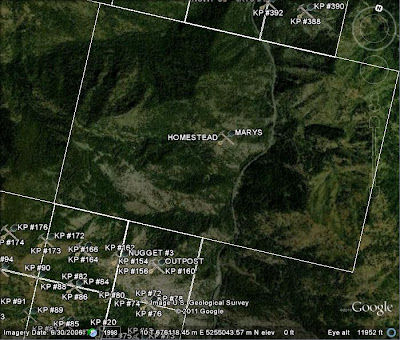
By way of example, clicking on the "Homestead" icon in the center of the screen opens a pop-up box with links to LR2000 information regarding the closed mining claims in this area:

More information about each claim is available by clicking on the "LR2000 MC Report" link for the claim of interest. That is if the link is not broken (as indicated by the red "crosses" at the left end of each data row in the picture) which can happen if LR2000 is down for maintenance or is having some other problem.
Information on active claims is accessed in a similar manner by selecting "BLM Mine Claim Records - Active."
The best procedure is to just install MineCache into your copy of Google Earth and play around with its features. You can also read the tutorial on the MineCache website which gives additional tips and details about the application. The link to the MineCache website is permanently available in the right-hand sidebar of this blog in the section headed "Resources for Prospectors."
Armchair gold prospecting just got a whole lot easier. Have fun!
The first step in getting MineCache running on your computer is to download and install Google Earth, which may be done by visiting the link in the first paragraph above and following the on-screen directions.
The next step is to download the MineCache.kml plug-in from the MineCache website linked at the start of this post. With Google Earth running on your computer, visit the download link at MineCache.com and, after registering, follow the instructions there. The MineCache folder will appear in the "Temporary Places" folder in the "Places" section of the left-hand sidebar. (When you exit Google Earth, you will be told you have unsaved items in the "Temporary Places" folder. If you want to keep the MineCache plug-in, click "Save.")
Here is a picture of my "Places" sidebar after installing MineCache (and saving it):

As you may notice, MineCache opens with the options "Auto Refresh," "All Gold Claims - MRDS," and "Zoom in closer" checked.
"Auto Refresh" means that as you move the view-port in Google Earth to a new location, after a second or two the display of gold claims will refresh. If you don't want that to happen by itself, select "Manual Refresh" lower in the list.
"All Gold Claims - MRDS" means that the data displayed is from the USGS Mineral Resource Data System; the same data source discussed in my previous articles on "Armchair Prospecting." In the case of MineCache, the data is pre-selected to show gold deposits only.
"Zoom in closer" means that you are too far out to display any gold locations. Use the zoom-in controls in Google Earth to get closer to the surface. Once you are within 100 miles of the ground, you will see a gold dot moving back and forth under the gold claims folder that is selected. This feature indicates that MineCache is checking for records of gold occurrences in the area of the view-port. When the dot stops moving and turns green, it means that the data search is complete. The "Zoom in closer" legend will be replaced with the number of mines, if any, found. Or, in the case of an area with lots of records, it may tell you to zoom in closer still for more results.
Let's take a look at a typical gold producing area near Blewett Pass in Washington:

Activating MineCache in its default mode (described above) results in the display of 58 locations in which gold was found either as the primary or as a secondary mineral:

More information is available about each of these locations by clicking on an icon in the Google Earth image. For example, if we click on the icon for the Bloom Placer (just above and to the right of the image center), a pop-up box appears with information about the deposit:

If we click on the "View more mine details" link inside the information box, a web page opens in the default browser (in this case, Google Chrome) displaying additional data:

Another feature of MineCache is its ability to display BLM mine claim records for both active and closed mines. These data come from the BLM's GeoCommunicator application and are therefore, as BLM warns, not as complete or accurate as the information provided by the BLM LR2000 site. However, as LR2000 data is not accessible via software while GeoCommunicator data is, it is best to use the MineCache BLM information for initial research on an area and, if the results are promising, go to LR2000 directly for the more up-to-date records.
Selecting "BLM Mine Claim Records - Closed" causes the icons previously displayed to clear and new information to show on the screen:

By way of example, clicking on the "Homestead" icon in the center of the screen opens a pop-up box with links to LR2000 information regarding the closed mining claims in this area:

More information about each claim is available by clicking on the "LR2000 MC Report" link for the claim of interest. That is if the link is not broken (as indicated by the red "crosses" at the left end of each data row in the picture) which can happen if LR2000 is down for maintenance or is having some other problem.
Information on active claims is accessed in a similar manner by selecting "BLM Mine Claim Records - Active."
The best procedure is to just install MineCache into your copy of Google Earth and play around with its features. You can also read the tutorial on the MineCache website which gives additional tips and details about the application. The link to the MineCache website is permanently available in the right-hand sidebar of this blog in the section headed "Resources for Prospectors."
Armchair gold prospecting just got a whole lot easier. Have fun!
Friday, March 11, 2011
House Schedules Hearing On HPA Fee Bill (HB 2008)
The companion bill in the House (HB 2008) to the Senate's SB 5862, which was given a public hearing on March 9, is scheduled to be heard before the House General Government Appropriations & Oversight Committee on March 15 at 8:00 A.M. in House Hearing Room C of the John L. O'Brien Building in Olympia.
For background on this set of bills, which would impose some rather stiff fees for Hydraulic Project Approvals outside of the Gold & Fish pamphlet, please refer to my previous post at the link here.
Updates will follow as needed.
For background on this set of bills, which would impose some rather stiff fees for Hydraulic Project Approvals outside of the Gold & Fish pamphlet, please refer to my previous post at the link here.
Updates will follow as needed.
Wednesday, March 2, 2011
WDFW Amends HPA Fee Bill; Hearing Scheduled
UPDATE!
March 4, 2011 at 6:36 P.M.
The hearing on SB 5862 has been rescheduled for March 9 at 8:00 A.M. in Senate Hearing Room 2 of the J. A. Cherberg Building in Olympia. Note that the room number is different from that given for the original hearing.
______________________________
UPDATE!
March 3, 2011 at 3:09 P.M.
The hearing on SB 5862 scheduled for March 4 has been canceled. As far as I am aware, no reason has yet been given. Nevertheless, it would be a good idea to continue contacting legislators with messages in opposition to this bill as otherwise we might be caught napping by events in Olympia.
More information as it becomes available.
______________________________
On February 3 I published a post regarding HB 1588 and its companion bill in the Senate, SB 5529, which together represent WDFW's latest attempt to implement prohibitive fees for mineral prospecting and mining under the Hydraulic Project Approval (HPA) process.
I have now received word that WDFW has "amended" SB 5529 from its original 20 pages to a new 38 page version dubbed SB 5862. (The companion bill in the House is HB 2008.) As I understand it, and I haven't had time to read the entire text of the substitute bill, the additional 18 pages do nothing to improve this proposal from the point of the small-scale mining community.
The reason I haven't, and won't, have time to read this bill before publishing this post is that SB 5862 is scheduled for a public hearing at 8:30 A.M. on Friday, March 4, before the Senate Natural Resources & Marine Waters Committee in Senate Hearing Room 3 of the J. A. Cherberg Building. Therefore, time is of the essence in getting word out about this bill and the coming public hearing.
If you can make it to Olympia on Friday to testify, here are some "talking points*" in favor of abolishing the entire HPA process:
The HPA program:
*Is antiquated, 62 years old
*Prior to 1949, was for the administration of irrigation/water rights.
*Financially burdens the taxpayers of the state through duplication of resources and permits as reported by the HPA Task Force in 2002.
*Financially burdens the taxpayers of the state through continual Legislation and Rule Making.
*Is cumbersome, subjective and unequally applied.
*Has been a subject of legislation for over 11 years.
* In 2008, HB2530, Studying the effectiveness of the existing hydraulic project approval process was introduced but not enacted because of budgetary constraints. This would have directed WDFW to study the effectiveness of the HPA program.
*Is a leading CAUSE of property loss experienced during river high flow or flood events.
*By elimination, will save $9 million dollars. This is a new concept to Legislators and agencies who are looking to increase revenue through the implementation of fee's.
*Has been through "Streamlining" for over 5 years without success. It is time to stop wasting the taxpayers money.
* "Talking points" courtesy of Bill Thomas, President of the Resources Coalition, via email from Bruce Beatty.
Wednesday, February 16, 2011
HB 1307 (Now SHB 1307) Referred To Ways & Means
HB 1307, which would require independent peer review for all science that is used in support of any proposed regulations affecting any activity government agencies, such as WDFW, claim is detrimental to the environment (see previous post here), passed the House Committee on Environment on February 10 in the form of a 1st substitute bill and was referred to the House Ways & Means Committee on February 15 with a "do pass" recommendation.
As passage of this bill by the Ways & Means Committee will be another step beneficial to the small-scale mining community, interested persons may want to contact the committee members at the link above and request that SHB 1307 be heard and given a "DO PASS" recommendation.
SB 5644, the companion bill in the Senate to SHB 1307, is currently languishing in the Environment, Water & Energy Committee and may benefit from polite requests for a hearing and a "DO PASS" recommendation as well.
WDFW Halts Rule-Making That Would Criminalize Prospecting
As reported in this blog here and here, WDFW has been seeking to amend WAC 232-12-251 to criminalize such activities as the removal of minerals from the department's lands. The latest move in this direction was the promised filing of a supplemental CR-102 on January 19th.
It now appears this will not happen as WDFW has withdrawn the original CR-102 filed last October 20. With the governor's moratorium on rule-making, WDFW anticipates filing a new CR-102 no earlier than 2012.
Those wishing to keep abreast of this seemingly ever-changing process may contact:
Lori Preuss, Rules Coordinator
600 Capitol Way N.
Olympia WA 98501-1091
Lori.Preuss@dfw.wa.gov
fax (360) 902-2155
Ask to be informed of any rule making associated with WAC 232-12-251 and remember to provide your contact information.
Thursday, February 3, 2011
WDFW's Requested HPA Bill Due For Hearing
HB 1588, WDFW's requested Hydraulic Project Approval bill, is up for public hearing at 10:00 A.M. on February 8, 2011 in House Hearing Rm D, John L. O'Brien Building in Olympia.
A quick reading of the bill's text reveals some less-than-desirable characteristics of the WDFW proposed "streamlining" process:
1. There are to be three classes of hydraulic projects: Class I covers activities permitted in the Gold & Fish pamphlet; Class II covers activities which are currently undefined and which will not be defined until completion of a rule making process by January 1, 2012. (Determination as to whether the aforementioned rules work would be by means of a "pilot project" conducted by WDFW and completed sometime in 2014); Class III covers any project which is neither Class I nor Class II which, for the remainder of this year, would be anything not permitted by the Gold & Fish pamphlet.
2. Then there is the matter of fees. Class I projects would be exempt from fees -- at least for the time being. For a Class II permit (once it's defined) the application fee is $150. The fee for a Class III permit is set at $1000 ($150 for notification/application plus $850 for processing). Also, a general Class II or Class III permit would require a fee of $5000. In some cases, partial or full refunds would be available and the fees will be indexed annually to inflation. See the bill text for details, if you want them.
3. Penalties. Each violation of the rules for HPAs would be treated as a "gross misdemeanor" with an accompanying fine of $10,000. WDFW would, however, initially seek "voluntary" compliance with the rules before resorting to the penalty provisions.
The above are what jumped out at me while quickly scanning the bill. Actually, the convoluted 20-page text of HB 1588 seems itself like Exhibit-A type evidence for passage of HB 1233 removing the hydraulic project approval process altogether. (See my earlier post on HB 1233 at the link here.)
Stay tuned for future developments.
------------------------------------
Update at 8:19 P.M. 2/3/11
A couple of notes due to revised schedules:
1. HB 1233 will be heard immediately after HB 1588 at the hearing on February 8th described above. The link to the House Agriculture & Natural Resources committee agenda is here.
2. SB 5529, the companion bill to HB 1588, will be heard in the Senate Natural Resources & Marine Waters committee at 8:00 A.M. on February 9, 2011 in Senate Hearing Rm 2, J.A. Cherberg Building, Olympia. The link to the agenda is here.
Wednesday, February 2, 2011
How Science Informs Policy - HB 1307
HB 1307 - concerning standards for the use of science to support public policy - will be the subject of a work session of the House Environment Committee at 1:30 P.M. on February 4, 2011 in House Hearing Room C, John L. O'Brien Building, Olympia, Washington. Immediately following the work session, the committee will hold a public hearing on the bill.
HB 1307 is important for miners because, if passed into law, it will require government agencies, such as WDFW, to obtain fully independent peer review for all science that is used in support of any public policy, such as "work windows" for suction dredging, etc. Peer review by qualified experts would verify the integrity of any science used to regulate the activities of citizens. This type of review would go a long way towards preventing regulations and/or statutes based on special-interest-agenda-driven pseudo-science.
It is therefore important that as many members of the mining community as possible provide testimony at the hearing in support of HB 1307. Written testimony may be presented to the committee and its members prior to the public hearing -- and the sooner the better. Oral testimony may be presented at the public hearing. Whether written or oral, testimony should adhere to the following general outline provided via Bruce Beatty:
- Tell the committee members who you are, where you live, and what you do that is impacted by science-driven public policies.
- Thank them for placing Washington in the forefront of ensuring that the science we use is fully verified before it is used to support public policy.
- Tell them your experience with how science has been used in policies that affect you personally. (Use your own story.)
-Tell them why you believe HB 1307 helps make things better.
- Please stick to the science issue . . . there are other bills where you can advocate for or against legislation covering specific issues that concern you.
- Thank them for their time and consideration of your testimony.
Even if you are giving oral testimony, it would be a good idea to bring a written copy as well to hand in. It would also be a good idea to send a copy of your testimony to Representative Jim McCune ( jim.mccune@leg.wa.gov ) as he is a co-sponsor of HB 1307 but is not on the committee.
Remember, as always, to maintain a positive tone in your remarks and an attitude of seeking to help the agencies in question do a better job of serving the public.
Thursday, January 27, 2011
Proposed Changes To HPAs: The Bad And The Good
First the bad news: Governor Gregoire wants to reduce the state's budget deficit by making the Hydraulic Project Approval (HPA) program fee-based. It seems WDFW has been working on legislation to make this happen and may be submitting their bill to the legislature within a week.
According to our information, if passed, the law would assess fees for a five-year Class 2 permit of $150 and for a five-year Class 3 permit of $1000 to $5000. There would be no fee for working within the constraints of the Gold & Fish pamphlet.
In order to prevent the foregoing fees from becoming an uncomfortable fact of life, members of the mining community should contact Governor Gregoire, the Senate Ways & Means Committee and the House Ways & Means Committee and voice their opposition to fee-based HPAs.
If you need "Talking Points" for your communications when you call, write, or fax the Governor and the committees, feel free to choose from those listed below:
*There will not be an increase in revenue as the largest users of the program are State Agencies;
*There will be an increase in cost to the agencies for accounting, and therefore to the taxpayers;
*The cost of the program will be borne by already financially strapped Counties;
*Federal agencies have ruled that Small Scale Mineral Prospecting and Mining is a less than significant activity and as such does not rise to the level of coming under the statute that regulates “construction projects in state waters;”
*Most Small Scale Mineral Prospectors and Miners are on fixed incomes and could never recover the cost of a permit;
*An unreasonable fee would create criminals as some people would not obtain a permit that they could not afford;
* A fee could eliminate the Small Scale Mineral Prospecting and Mining community which is a significant part of Washington State's Heritage;
*Any fee imposed must be reasonably based on the scope of the activity and as the scope of the activity is essentially non-existent, so should be any fee;
*If a fee is to be imposed to our less than significant activity, it should be imposed upon ALL activities that utilize the HPA program.
And do remember to include your name, address, and phone number in any correspondence in case someone wishes to contact you for more information.
And now for the good news: On January 17, HB 1233 ("Streamlining state environmental permitting through the elimination of the hydraulics project approval process") was introduced. The next step is for it to be heard by the House Agriculture & Natural Resources Committee.
As it appears this bill is the best shot the mining community is likely to get this year for the elimination of the HPA requirement, miners are advised to 1) contact their district Senator and request that he/she look at HB 1233 and sponsor a companion bill in the Senate and 2) contact the Agriculture & Natural Resources Committee asking that HB 1233 be heard and passed out with a “Do Pass” recommendation and give your “PRO” vote.
Some examples of "Talking Points" to include with your communication are:
*At 62 years of age the HPA process is antiquated;
*Prior to 1949, this process was for the administration of irrigation/water rights;
*The HPA program financially burdens the citizens of the state through duplication of resources;
*The HPA program is cumbersome, subjective and unequally applied;
*The HPA program has been a subject of legislation for over 11 years;
*The HPA Task Force reported in 2002 that the program duplicates other permits;
* In 2008, HB 2530, "Studying the effectiveness of the existing hydraulic project approval process," was introduced. This study would have considered the effectiveness of legislative enactments, implementation by WDFW, and the impact that historic funding levels have had on the program's effectiveness, with focus on both the level of compliance as well as the actual fish protection offered in instances of full compliance. This legislation was not enacted;
*HPA’s are being required for projects that do not “use, divert, obstruct, or change the natural flow or bed of any of the salt or fresh waters of the state,” such as bridge painting or guard rail replacement;
*The HPA process is a leading CAUSE of property loss experienced during high river flow or flood events.
Again, remember to include your contact information with your correspondence.
More Government By Stealth?
As reported in this post last November, WDFW is proposing to criminalize the removal of such things as "dead standing timber, live trees, wood, soil, petrified wood, minerals, fossils, (and) plants" from "WDFW lands."
Information just received indicates that at the meeting on December 4, 2010 the Fish and Wildlife Commission voted to postpone the adoption of WDFW's proposed amendment to WAC 232-12-251 until their March 4-5, 2011 meeting. During the interim period, WDFW is supposed to work with stakeholders to refine the proposed rule changes. According to WDFW's Rules Information Website, a "supplemental CR-102 will be filed by January 19, 2011" and "(p)rior to that time, the department will work with stakeholders to refine the proposed rule changes."
In addition, the website further states:
A new public comment period will begin on January 19, 2011. Written comments will be due by February 25, 2011. Written comment may be e-mailed to lori.preuss@dfw.wa.gov.
Interestingly enough, our information is that, contrary to the above, "there have been no meetings with stakeholders and a supplemental (CR-102) has not been filed."
For these reasons, it would seem prudent for miners to "contact Lori Preuss at (360) 902-2930 or lori.preuss@dfw.wa.gov and request to be informed of any rule making activity associated with WAC 232-12-251"as well as checking WDFW’s Rules information Website often.
Tuesday, November 30, 2010
WDFW Seeks To Criminalize Prospecting And Mining On Its Lands
In a series of moves that reek of "government by stealth," a WDFW news release of November 24, 2010 titled, "Commission to consider restricting the use of lead fishing tackle on lakes with loons," contains the buried morsel that the commission is also scheduled to hold public hearings on "Amendments to rules governing the removal of minerals, wood and artifacts from WDFW lands." (Emphasis added.)
According to the WDFW Rules Notification Center, the original notification of this proposed rule change (CR-101) was filed on January 6, 2010 and only mentions "large, old snags ... being cut down for firewood" as the reason for the proposed modifications. The subsequent "Notice and opportunity to comment on this current rule-making proposal" (CR-102) was filed on October 20, 2010 and contained the following language:
Purpose of the proposal and its anticipated effects, including any changes in existing rules: The department currently lacks the ability to prohibit people from cutting down snags and taking mushrooms and berries on land it owns or controls.
Reasons supporting proposal: Snags provide habitat for many species. This proposal will protect that habitat from destruction. The proposal will also minimize the amount of downed dead wood that people can collect and use on the department’s lands, and it will limit the amount of mushrooms that can be taken, to conserve these resources.
It's only when you get to the very end of the document that you find the new language that is of concern to miners:
Unlawful cutting down or removal of dead standing timber, live trees, wood, soil, petrified wood, minerals, fossils, or plants constitutes theft under chapter 9A.56 RCW. (Emphasis added.)
Of particular concern is that this proposal has gone so far towards implementation without the knowledge or involvement of the small-scale mineral prospecting and mining community.
Although the period for written comment (confusingly) ends on December 5, 2010 (Written comment may be e-mailed to lori.preuss@dfw.wa.gov ), the Green Sheet for this action item notes that the Fish and Wildlife Commission will "Receive the staff presentation and any comments from the public." According to the agenda for the December meeting of the Fish and Wildlife Commission, this presentation and comment session will take place at 8:30 AM on Saturday, December 4 in NRB Room 172.
Given the shortness of time remaining to respond to this issue, comments should be sent to the email address in the paragraph above, and/or directed to the Fish and Wildlife Commission at:
Mailing Address:
600 Capitol Way N.
Olympia, WA 98501-1091
Phone: 360-902-2267
Fax: 360-902-2448
commission@dfw.wa.gov
and/or delivered in person at the meeting on December 4 at:
Natural Resources Building
First Floor, Room 175 & 172
1111 Washington St. SE
Olympia, Washington 98501
Subscribe to:
Posts (Atom)