As posted here on Monday, a public hearing on SSB 5862, the substitute HPA fee bill, was held on Tuesday before the Senate Committee on Ways & Means.
We now learn, via the Resources Coalition and Bruce Beatty, that a second substitute bill (P2SSB 5862) has been proposed as the result of a meeting between the Governor's Office and some "HPA program Stakeholders" and from which meeting the Small Scale Mineral Prospecting and Mining Community was excluded.
It is important to read the text of this new legislation which may be downloaded as a PDF file here. (Note: This file will open in a pdf reader although it does not have a .pdf extension. You may have to manually select your pdf reader in order to view this file.) But, in summary, the bill is poorly written and, if enacted, would severely restrict, if not eliminate, one's ability to prospect or mine in this state.
Accordingly, here is a link to a somewhat lengthy list of talking points to use when contacting the government departments listed below: P2SSB 5862Talking Points PDF
Senate Committee on Ways & Means - to request that this bill not be allowed to go forward and cite your concerns.
Governor's Office - to ask why was the Small Scale Mineral Prospecting and Mining community was not a part of her meetings regarding this legislation and cite your concerns.
Your Senator and Representative - to inform them of this legislation and of your concerns. Request that they take whatever steps that they can to stop this legislation.
Your Local County, City, and Dike Districts - to inform them of this legislation. They need to know your position as a taxpayer who will ultimately end up paying for this legislation. Just because they may not obtain an HPA or FPA, they will be on the hook for prosecuting violators.
Furthermore, if you wish to call or write the Governor's Office, the contact information is listed below:
Phone: 360-902-4111
Fax: 360-753-4110
Mailing Address:
Governor Chris Gregoire
Office of the Governor
PO Box 40002
Olympia, WA 98504-0002
Thursday, April 21, 2011


Monday, April 18, 2011
Sneak Attack Hearing On HPA Fee Bill Tomorrow In Olympia - UPDATED!
UPDATE 4/19/11 -- If you need them, here are some talking points in opposition to SSB 5862 from Bruce Beatty:
9. There will be an INCREASE of expenditures by the State, the Agencies, and by Counties. Take a look at the fiscal notes and notice the amount that will be required for capital expenditures and the number of additional employee's that must be hired. This is not a reduction of government or streamlining.
Please pass this information on to all who use or may use the HPA program. This includes those with Bulkheads, Marina's or Landscape management plans that select fish for coverage under such a plan and to those who fall under the Forest Practices Permit.
If you are able to attend the public hearings, please do so, and do not forget to sign in and mark your position (CON).
-------------------------------
The HPA Fee bill (SB 5862 and HB 2008) has arrived in a new incarnation called SSB 5862 and -- SURPRISE! -- is scheduled for a public hearing TOMORROW before the Senate Committee on Ways & Means.
As of this writing, the time and place are 2:30 P.M. in the J. A. Cherberg Building, Senate Hearing Room 4 in Olympia.
The text of the bill may be downloaded from the link: SSB 5862, titled AN ACT Relating to the administration of natural resources programs.
The link for the Legislative Bill Information Website page for this bill is here.
If you cannot attend the hearing, you may send comments via phone or email to the committee members using the information at the link here. Click on each committee member's name to be taken to their homepage where an email link is available.
More news as it develops.
1. The bill was poorly haphazardly created containing obvious errors;
a) 2 definitions for "sandbar"
b) Section 103 states that the department "shall charge a one hundred fifty dollar submittal fee and a processing fee.." but the next paragraph states that "The department shall charge a seventy-five dollar submittal fee for single site low complexity hydraulic project permits"
c) Bill summaries and Fiscal notes state that the Gold and Fish Pamplet HPA's are exempt from fee's, but there is no language in the bill to support these statements.
d) Establishes a fee structure, then provides DFW the authority to reduce fee's based upon circumstances and at "it's discretion." There is no specific provision for reimbursement, (fee's must be paid in advance) and there is no check or balance as to whom gets the reduced fee allowing favoritism or Fraud.
2. This legislation will expand WDFW's regulatory authority. In addition to being required below the Ordinary High Water Line, HPA's will be required for certain activities (A dike, levee, bridge, shoreline or streambank protection project (new definition), or mineral prospecting and mining) in the channel migration zone (new definition), one hundred year floodplain (new definition), or within two hundred feet landward of the ordinary high water line.
3. Projects that expend enormous amounts of time, resources and $money$, such as fish passage barrier and fish habitat enhancement projects are exempted from all fees. The organizations who fall under this category already receive a Streamlined Permit process under RCW 77.55.181, and in most cases receive funding through grants. Permits issued under this statute are already exempted from permits and fee's by local governments.
4. The legislation makes no provisions that would allow an individual to obtain a permit for less than a five year term at a reduced fee.
6. The title of this statute will change to the "Hydraulic Code" from "Construction projects in state waters" which will forever change what the original intent of this legislation was when established in 1943.
7. Establishes a civil penalty of up to $10,000 per violation. This is up from $100 per day and is in addition the the Gross Misdemeanor Charge, punishable by up to one year in jail and/or a $5,000 fine. The lowest penalty proposed is $2,500.
9. There will be an INCREASE of expenditures by the State, the Agencies, and by Counties. Take a look at the fiscal notes and notice the amount that will be required for capital expenditures and the number of additional employee's that must be hired. This is not a reduction of government or streamlining.
Please pass this information on to all who use or may use the HPA program. This includes those with Bulkheads, Marina's or Landscape management plans that select fish for coverage under such a plan and to those who fall under the Forest Practices Permit.
If you are able to attend the public hearings, please do so, and do not forget to sign in and mark your position (CON).
-------------------------------
The HPA Fee bill (SB 5862 and HB 2008) has arrived in a new incarnation called SSB 5862 and -- SURPRISE! -- is scheduled for a public hearing TOMORROW before the Senate Committee on Ways & Means.
As of this writing, the time and place are 2:30 P.M. in the J. A. Cherberg Building, Senate Hearing Room 4 in Olympia.
The text of the bill may be downloaded from the link: SSB 5862, titled AN ACT Relating to the administration of natural resources programs.
The link for the Legislative Bill Information Website page for this bill is here.
If you cannot attend the hearing, you may send comments via phone or email to the committee members using the information at the link here. Click on each committee member's name to be taken to their homepage where an email link is available.
More news as it develops.
Thursday, April 7, 2011
Presentation on Beach Mining Pilot Program Cancelled
Word just in from Olympia is that the presentation on the Ocean Beach Mining Pilot Program scheduled for 8:00 A.M. tomorrow before the House Agriculture & Natural Resources Committee by WDFW and the State Parks and Recreation Commission has been canceled. No word yet on when it might be rescheduled but WSM will keep you posted.
For background information on this subject, see my earlier post here.
For background information on this subject, see my earlier post here.
Thursday, March 31, 2011
Upcoming Legislation Would Restore Wilderness Study, Roadless Areas to Multiple Use Status
Congressman Kevin McCarthy of California's 22nd District plans to introduce the "Wilderness and Roadless Area Release Act¹” in the near future. The purpose of this legislation is to "release all Wilderness Study Areas and Inventoried Roadless Areas, which have been recommended as not suitable for wilderness by the Bureau of Land Management or the United State(s) Forest Service, and direct that they be managed for multiple use.²" The effect, if this bill becomes law, would be to open more land for prospecting and mining as well as for other public uses.
At present, advocates of this bill are requesting that organizations (not individuals) send an email to Ben McFarland at Congressman McCarthy's office (benjamin.mcfarland@mail.house.gov) asking him to add the organization's name to the list of supporters and to also ask their Congressperson to co-sponsor this legislation. After contacting their Congressperson's office, they can download and send them this "Dear Colleague" letter.
More documentation in .pdf format regarding this bill:
Overview of the bill
Text of the bill
More information as it becomes available.
¹ Forwarded email from Chris Horgan at "Save the Trails"
² Ibid.
At present, advocates of this bill are requesting that organizations (not individuals) send an email to Ben McFarland at Congressman McCarthy's office (benjamin.mcfarland@mail.house.gov) asking him to add the organization's name to the list of supporters and to also ask their Congressperson to co-sponsor this legislation. After contacting their Congressperson's office, they can download and send them this "Dear Colleague" letter.
More documentation in .pdf format regarding this bill:
Overview of the bill
Text of the bill
More information as it becomes available.
¹ Forwarded email from Chris Horgan at "Save the Trails"
² Ibid.
House Committee to Hear Presentation on Beach Mining Pilot Program
The latest development in the long-in-coming opportunity to mine gold at Washington's ocean beaches will be on April 8 before the House Agriculture & Natural Resources Committee. According to the current agenda, this work session will include a "(j)oint presentation by the Department of Fish and Wildlife and the Parks and Recreation Commission on the findings of the Small Scale Mining and Prospecting on Ocean Beaches Pilot Program." As this meeting is not open for public testimony, I mention it here for information only.
For some background on the "Beach Mining Pilot Program," see my earlier posts here, here, and here.
Washington State Miner will continue to follow and report on this story.
For some background on the "Beach Mining Pilot Program," see my earlier posts here, here, and here.
Washington State Miner will continue to follow and report on this story.
Monday, March 21, 2011
MineCache: A Google Earth Plug-in For Gold Prospectors
MineCache is a free plug-in for Google Earth that displays a wealth of information regarding locations where gold has been found in the past. That is to say, those locations where gold is most likely to be found in the present. MineCache displays gold deposit information for the entire United States, including Alaska.
The first step in getting MineCache running on your computer is to download and install Google Earth, which may be done by visiting the link in the first paragraph above and following the on-screen directions.
The next step is to download the MineCache.kml plug-in from the MineCache website linked at the start of this post. With Google Earth running on your computer, visit the download link at MineCache.com and, after registering, follow the instructions there. The MineCache folder will appear in the "Temporary Places" folder in the "Places" section of the left-hand sidebar. (When you exit Google Earth, you will be told you have unsaved items in the "Temporary Places" folder. If you want to keep the MineCache plug-in, click "Save.")
Here is a picture of my "Places" sidebar after installing MineCache (and saving it):

As you may notice, MineCache opens with the options "Auto Refresh," "All Gold Claims - MRDS," and "Zoom in closer" checked.
"Auto Refresh" means that as you move the view-port in Google Earth to a new location, after a second or two the display of gold claims will refresh. If you don't want that to happen by itself, select "Manual Refresh" lower in the list.
"All Gold Claims - MRDS" means that the data displayed is from the USGS Mineral Resource Data System; the same data source discussed in my previous articles on "Armchair Prospecting." In the case of MineCache, the data is pre-selected to show gold deposits only.
"Zoom in closer" means that you are too far out to display any gold locations. Use the zoom-in controls in Google Earth to get closer to the surface. Once you are within 100 miles of the ground, you will see a gold dot moving back and forth under the gold claims folder that is selected. This feature indicates that MineCache is checking for records of gold occurrences in the area of the view-port. When the dot stops moving and turns green, it means that the data search is complete. The "Zoom in closer" legend will be replaced with the number of mines, if any, found. Or, in the case of an area with lots of records, it may tell you to zoom in closer still for more results.
Let's take a look at a typical gold producing area near Blewett Pass in Washington:

Activating MineCache in its default mode (described above) results in the display of 58 locations in which gold was found either as the primary or as a secondary mineral:

More information is available about each of these locations by clicking on an icon in the Google Earth image. For example, if we click on the icon for the Bloom Placer (just above and to the right of the image center), a pop-up box appears with information about the deposit:

If we click on the "View more mine details" link inside the information box, a web page opens in the default browser (in this case, Google Chrome) displaying additional data:

Another feature of MineCache is its ability to display BLM mine claim records for both active and closed mines. These data come from the BLM's GeoCommunicator application and are therefore, as BLM warns, not as complete or accurate as the information provided by the BLM LR2000 site. However, as LR2000 data is not accessible via software while GeoCommunicator data is, it is best to use the MineCache BLM information for initial research on an area and, if the results are promising, go to LR2000 directly for the more up-to-date records.
Selecting "BLM Mine Claim Records - Closed" causes the icons previously displayed to clear and new information to show on the screen:
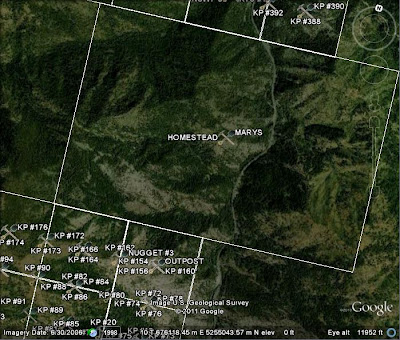
By way of example, clicking on the "Homestead" icon in the center of the screen opens a pop-up box with links to LR2000 information regarding the closed mining claims in this area:

More information about each claim is available by clicking on the "LR2000 MC Report" link for the claim of interest. That is if the link is not broken (as indicated by the red "crosses" at the left end of each data row in the picture) which can happen if LR2000 is down for maintenance or is having some other problem.
Information on active claims is accessed in a similar manner by selecting "BLM Mine Claim Records - Active."
The best procedure is to just install MineCache into your copy of Google Earth and play around with its features. You can also read the tutorial on the MineCache website which gives additional tips and details about the application. The link to the MineCache website is permanently available in the right-hand sidebar of this blog in the section headed "Resources for Prospectors."
Armchair gold prospecting just got a whole lot easier. Have fun!
The first step in getting MineCache running on your computer is to download and install Google Earth, which may be done by visiting the link in the first paragraph above and following the on-screen directions.
The next step is to download the MineCache.kml plug-in from the MineCache website linked at the start of this post. With Google Earth running on your computer, visit the download link at MineCache.com and, after registering, follow the instructions there. The MineCache folder will appear in the "Temporary Places" folder in the "Places" section of the left-hand sidebar. (When you exit Google Earth, you will be told you have unsaved items in the "Temporary Places" folder. If you want to keep the MineCache plug-in, click "Save.")
Here is a picture of my "Places" sidebar after installing MineCache (and saving it):

As you may notice, MineCache opens with the options "Auto Refresh," "All Gold Claims - MRDS," and "Zoom in closer" checked.
"Auto Refresh" means that as you move the view-port in Google Earth to a new location, after a second or two the display of gold claims will refresh. If you don't want that to happen by itself, select "Manual Refresh" lower in the list.
"All Gold Claims - MRDS" means that the data displayed is from the USGS Mineral Resource Data System; the same data source discussed in my previous articles on "Armchair Prospecting." In the case of MineCache, the data is pre-selected to show gold deposits only.
"Zoom in closer" means that you are too far out to display any gold locations. Use the zoom-in controls in Google Earth to get closer to the surface. Once you are within 100 miles of the ground, you will see a gold dot moving back and forth under the gold claims folder that is selected. This feature indicates that MineCache is checking for records of gold occurrences in the area of the view-port. When the dot stops moving and turns green, it means that the data search is complete. The "Zoom in closer" legend will be replaced with the number of mines, if any, found. Or, in the case of an area with lots of records, it may tell you to zoom in closer still for more results.
Let's take a look at a typical gold producing area near Blewett Pass in Washington:

Activating MineCache in its default mode (described above) results in the display of 58 locations in which gold was found either as the primary or as a secondary mineral:

More information is available about each of these locations by clicking on an icon in the Google Earth image. For example, if we click on the icon for the Bloom Placer (just above and to the right of the image center), a pop-up box appears with information about the deposit:

If we click on the "View more mine details" link inside the information box, a web page opens in the default browser (in this case, Google Chrome) displaying additional data:

Another feature of MineCache is its ability to display BLM mine claim records for both active and closed mines. These data come from the BLM's GeoCommunicator application and are therefore, as BLM warns, not as complete or accurate as the information provided by the BLM LR2000 site. However, as LR2000 data is not accessible via software while GeoCommunicator data is, it is best to use the MineCache BLM information for initial research on an area and, if the results are promising, go to LR2000 directly for the more up-to-date records.
Selecting "BLM Mine Claim Records - Closed" causes the icons previously displayed to clear and new information to show on the screen:

By way of example, clicking on the "Homestead" icon in the center of the screen opens a pop-up box with links to LR2000 information regarding the closed mining claims in this area:

More information about each claim is available by clicking on the "LR2000 MC Report" link for the claim of interest. That is if the link is not broken (as indicated by the red "crosses" at the left end of each data row in the picture) which can happen if LR2000 is down for maintenance or is having some other problem.
Information on active claims is accessed in a similar manner by selecting "BLM Mine Claim Records - Active."
The best procedure is to just install MineCache into your copy of Google Earth and play around with its features. You can also read the tutorial on the MineCache website which gives additional tips and details about the application. The link to the MineCache website is permanently available in the right-hand sidebar of this blog in the section headed "Resources for Prospectors."
Armchair gold prospecting just got a whole lot easier. Have fun!
Friday, March 11, 2011
House Schedules Hearing On HPA Fee Bill (HB 2008)
The companion bill in the House (HB 2008) to the Senate's SB 5862, which was given a public hearing on March 9, is scheduled to be heard before the House General Government Appropriations & Oversight Committee on March 15 at 8:00 A.M. in House Hearing Room C of the John L. O'Brien Building in Olympia.
For background on this set of bills, which would impose some rather stiff fees for Hydraulic Project Approvals outside of the Gold & Fish pamphlet, please refer to my previous post at the link here.
Updates will follow as needed.
For background on this set of bills, which would impose some rather stiff fees for Hydraulic Project Approvals outside of the Gold & Fish pamphlet, please refer to my previous post at the link here.
Updates will follow as needed.
Wednesday, March 2, 2011
WDFW Amends HPA Fee Bill; Hearing Scheduled
UPDATE!
March 4, 2011 at 6:36 P.M.
The hearing on SB 5862 has been rescheduled for March 9 at 8:00 A.M. in Senate Hearing Room 2 of the J. A. Cherberg Building in Olympia. Note that the room number is different from that given for the original hearing.
______________________________
UPDATE!
March 3, 2011 at 3:09 P.M.
The hearing on SB 5862 scheduled for March 4 has been canceled. As far as I am aware, no reason has yet been given. Nevertheless, it would be a good idea to continue contacting legislators with messages in opposition to this bill as otherwise we might be caught napping by events in Olympia.
More information as it becomes available.
______________________________
On February 3 I published a post regarding HB 1588 and its companion bill in the Senate, SB 5529, which together represent WDFW's latest attempt to implement prohibitive fees for mineral prospecting and mining under the Hydraulic Project Approval (HPA) process.
I have now received word that WDFW has "amended" SB 5529 from its original 20 pages to a new 38 page version dubbed SB 5862. (The companion bill in the House is HB 2008.) As I understand it, and I haven't had time to read the entire text of the substitute bill, the additional 18 pages do nothing to improve this proposal from the point of the small-scale mining community.
The reason I haven't, and won't, have time to read this bill before publishing this post is that SB 5862 is scheduled for a public hearing at 8:30 A.M. on Friday, March 4, before the Senate Natural Resources & Marine Waters Committee in Senate Hearing Room 3 of the J. A. Cherberg Building. Therefore, time is of the essence in getting word out about this bill and the coming public hearing.
If you can make it to Olympia on Friday to testify, here are some "talking points*" in favor of abolishing the entire HPA process:
The HPA program:
*Is antiquated, 62 years old
*Prior to 1949, was for the administration of irrigation/water rights.
*Financially burdens the taxpayers of the state through duplication of resources and permits as reported by the HPA Task Force in 2002.
*Financially burdens the taxpayers of the state through continual Legislation and Rule Making.
*Is cumbersome, subjective and unequally applied.
*Has been a subject of legislation for over 11 years.
* In 2008, HB2530, Studying the effectiveness of the existing hydraulic project approval process was introduced but not enacted because of budgetary constraints. This would have directed WDFW to study the effectiveness of the HPA program.
*Is a leading CAUSE of property loss experienced during river high flow or flood events.
*By elimination, will save $9 million dollars. This is a new concept to Legislators and agencies who are looking to increase revenue through the implementation of fee's.
*Has been through "Streamlining" for over 5 years without success. It is time to stop wasting the taxpayers money.
* "Talking points" courtesy of Bill Thomas, President of the Resources Coalition, via email from Bruce Beatty.
March 4, 2011 at 6:36 P.M.
The hearing on SB 5862 has been rescheduled for March 9 at 8:00 A.M. in Senate Hearing Room 2 of the J. A. Cherberg Building in Olympia. Note that the room number is different from that given for the original hearing.
______________________________
UPDATE!
March 3, 2011 at 3:09 P.M.
The hearing on SB 5862 scheduled for March 4 has been canceled. As far as I am aware, no reason has yet been given. Nevertheless, it would be a good idea to continue contacting legislators with messages in opposition to this bill as otherwise we might be caught napping by events in Olympia.
More information as it becomes available.
______________________________
On February 3 I published a post regarding HB 1588 and its companion bill in the Senate, SB 5529, which together represent WDFW's latest attempt to implement prohibitive fees for mineral prospecting and mining under the Hydraulic Project Approval (HPA) process.
I have now received word that WDFW has "amended" SB 5529 from its original 20 pages to a new 38 page version dubbed SB 5862. (The companion bill in the House is HB 2008.) As I understand it, and I haven't had time to read the entire text of the substitute bill, the additional 18 pages do nothing to improve this proposal from the point of the small-scale mining community.
The reason I haven't, and won't, have time to read this bill before publishing this post is that SB 5862 is scheduled for a public hearing at 8:30 A.M. on Friday, March 4, before the Senate Natural Resources & Marine Waters Committee in Senate Hearing Room 3 of the J. A. Cherberg Building. Therefore, time is of the essence in getting word out about this bill and the coming public hearing.
If you can make it to Olympia on Friday to testify, here are some "talking points*" in favor of abolishing the entire HPA process:
The HPA program:
*Is antiquated, 62 years old
*Prior to 1949, was for the administration of irrigation/water rights.
*Financially burdens the taxpayers of the state through duplication of resources and permits as reported by the HPA Task Force in 2002.
*Financially burdens the taxpayers of the state through continual Legislation and Rule Making.
*Is cumbersome, subjective and unequally applied.
*Has been a subject of legislation for over 11 years.
* In 2008, HB2530, Studying the effectiveness of the existing hydraulic project approval process was introduced but not enacted because of budgetary constraints. This would have directed WDFW to study the effectiveness of the HPA program.
*Is a leading CAUSE of property loss experienced during river high flow or flood events.
*By elimination, will save $9 million dollars. This is a new concept to Legislators and agencies who are looking to increase revenue through the implementation of fee's.
*Has been through "Streamlining" for over 5 years without success. It is time to stop wasting the taxpayers money.
* "Talking points" courtesy of Bill Thomas, President of the Resources Coalition, via email from Bruce Beatty.
Wednesday, February 16, 2011
HB 1307 (Now SHB 1307) Referred To Ways & Means
HB 1307, which would require independent peer review for all science that is used in support of any proposed regulations affecting any activity government agencies, such as WDFW, claim is detrimental to the environment (see previous post here), passed the House Committee on Environment on February 10 in the form of a 1st substitute bill and was referred to the House Ways & Means Committee on February 15 with a "do pass" recommendation.
As passage of this bill by the Ways & Means Committee will be another step beneficial to the small-scale mining community, interested persons may want to contact the committee members at the link above and request that SHB 1307 be heard and given a "DO PASS" recommendation.
SB 5644, the companion bill in the Senate to SHB 1307, is currently languishing in the Environment, Water & Energy Committee and may benefit from polite requests for a hearing and a "DO PASS" recommendation as well.
As passage of this bill by the Ways & Means Committee will be another step beneficial to the small-scale mining community, interested persons may want to contact the committee members at the link above and request that SHB 1307 be heard and given a "DO PASS" recommendation.
SB 5644, the companion bill in the Senate to SHB 1307, is currently languishing in the Environment, Water & Energy Committee and may benefit from polite requests for a hearing and a "DO PASS" recommendation as well.
WDFW Halts Rule-Making That Would Criminalize Prospecting
As reported in this blog here and here, WDFW has been seeking to amend WAC 232-12-251 to criminalize such activities as the removal of minerals from the department's lands. The latest move in this direction was the promised filing of a supplemental CR-102 on January 19th.
It now appears this will not happen as WDFW has withdrawn the original CR-102 filed last October 20. With the governor's moratorium on rule-making, WDFW anticipates filing a new CR-102 no earlier than 2012.
Those wishing to keep abreast of this seemingly ever-changing process may contact:
Lori Preuss, Rules Coordinator
600 Capitol Way N.
Olympia WA 98501-1091
Lori.Preuss@dfw.wa.gov
fax (360) 902-2155
Ask to be informed of any rule making associated with WAC 232-12-251 and remember to provide your contact information.
It now appears this will not happen as WDFW has withdrawn the original CR-102 filed last October 20. With the governor's moratorium on rule-making, WDFW anticipates filing a new CR-102 no earlier than 2012.
Those wishing to keep abreast of this seemingly ever-changing process may contact:
Lori Preuss, Rules Coordinator
600 Capitol Way N.
Olympia WA 98501-1091
Lori.Preuss@dfw.wa.gov
fax (360) 902-2155
Ask to be informed of any rule making associated with WAC 232-12-251 and remember to provide your contact information.
Thursday, February 3, 2011
WDFW's Requested HPA Bill Due For Hearing
HB 1588, WDFW's requested Hydraulic Project Approval bill, is up for public hearing at 10:00 A.M. on February 8, 2011 in House Hearing Rm D, John L. O'Brien Building in Olympia.
A quick reading of the bill's text reveals some less-than-desirable characteristics of the WDFW proposed "streamlining" process:
1. There are to be three classes of hydraulic projects: Class I covers activities permitted in the Gold & Fish pamphlet; Class II covers activities which are currently undefined and which will not be defined until completion of a rule making process by January 1, 2012. (Determination as to whether the aforementioned rules work would be by means of a "pilot project" conducted by WDFW and completed sometime in 2014); Class III covers any project which is neither Class I nor Class II which, for the remainder of this year, would be anything not permitted by the Gold & Fish pamphlet.
2. Then there is the matter of fees. Class I projects would be exempt from fees -- at least for the time being. For a Class II permit (once it's defined) the application fee is $150. The fee for a Class III permit is set at $1000 ($150 for notification/application plus $850 for processing). Also, a general Class II or Class III permit would require a fee of $5000. In some cases, partial or full refunds would be available and the fees will be indexed annually to inflation. See the bill text for details, if you want them.
3. Penalties. Each violation of the rules for HPAs would be treated as a "gross misdemeanor" with an accompanying fine of $10,000. WDFW would, however, initially seek "voluntary" compliance with the rules before resorting to the penalty provisions.
The above are what jumped out at me while quickly scanning the bill. Actually, the convoluted 20-page text of HB 1588 seems itself like Exhibit-A type evidence for passage of HB 1233 removing the hydraulic project approval process altogether. (See my earlier post on HB 1233 at the link here.)
Stay tuned for future developments.
------------------------------------
Update at 8:19 P.M. 2/3/11
A couple of notes due to revised schedules:
1. HB 1233 will be heard immediately after HB 1588 at the hearing on February 8th described above. The link to the House Agriculture & Natural Resources committee agenda is here.
2. SB 5529, the companion bill to HB 1588, will be heard in the Senate Natural Resources & Marine Waters committee at 8:00 A.M. on February 9, 2011 in Senate Hearing Rm 2, J.A. Cherberg Building, Olympia. The link to the agenda is here.
A quick reading of the bill's text reveals some less-than-desirable characteristics of the WDFW proposed "streamlining" process:
1. There are to be three classes of hydraulic projects: Class I covers activities permitted in the Gold & Fish pamphlet; Class II covers activities which are currently undefined and which will not be defined until completion of a rule making process by January 1, 2012. (Determination as to whether the aforementioned rules work would be by means of a "pilot project" conducted by WDFW and completed sometime in 2014); Class III covers any project which is neither Class I nor Class II which, for the remainder of this year, would be anything not permitted by the Gold & Fish pamphlet.
2. Then there is the matter of fees. Class I projects would be exempt from fees -- at least for the time being. For a Class II permit (once it's defined) the application fee is $150. The fee for a Class III permit is set at $1000 ($150 for notification/application plus $850 for processing). Also, a general Class II or Class III permit would require a fee of $5000. In some cases, partial or full refunds would be available and the fees will be indexed annually to inflation. See the bill text for details, if you want them.
3. Penalties. Each violation of the rules for HPAs would be treated as a "gross misdemeanor" with an accompanying fine of $10,000. WDFW would, however, initially seek "voluntary" compliance with the rules before resorting to the penalty provisions.
The above are what jumped out at me while quickly scanning the bill. Actually, the convoluted 20-page text of HB 1588 seems itself like Exhibit-A type evidence for passage of HB 1233 removing the hydraulic project approval process altogether. (See my earlier post on HB 1233 at the link here.)
Stay tuned for future developments.
------------------------------------
Update at 8:19 P.M. 2/3/11
A couple of notes due to revised schedules:
1. HB 1233 will be heard immediately after HB 1588 at the hearing on February 8th described above. The link to the House Agriculture & Natural Resources committee agenda is here.
2. SB 5529, the companion bill to HB 1588, will be heard in the Senate Natural Resources & Marine Waters committee at 8:00 A.M. on February 9, 2011 in Senate Hearing Rm 2, J.A. Cherberg Building, Olympia. The link to the agenda is here.
Wednesday, February 2, 2011
How Science Informs Policy - HB 1307
HB 1307 - concerning standards for the use of science to support public policy - will be the subject of a work session of the House Environment Committee at 1:30 P.M. on February 4, 2011 in House Hearing Room C, John L. O'Brien Building, Olympia, Washington. Immediately following the work session, the committee will hold a public hearing on the bill.
HB 1307 is important for miners because, if passed into law, it will require government agencies, such as WDFW, to obtain fully independent peer review for all science that is used in support of any public policy, such as "work windows" for suction dredging, etc. Peer review by qualified experts would verify the integrity of any science used to regulate the activities of citizens. This type of review would go a long way towards preventing regulations and/or statutes based on special-interest-agenda-driven pseudo-science.
It is therefore important that as many members of the mining community as possible provide testimony at the hearing in support of HB 1307. Written testimony may be presented to the committee and its members prior to the public hearing -- and the sooner the better. Oral testimony may be presented at the public hearing. Whether written or oral, testimony should adhere to the following general outline provided via Bruce Beatty:
- Tell the committee members who you are, where you live, and what you do that is impacted by science-driven public policies.
- Thank them for placing Washington in the forefront of ensuring that the science we use is fully verified before it is used to support public policy.
- Tell them your experience with how science has been used in policies that affect you personally. (Use your own story.)
-Tell them why you believe HB 1307 helps make things better.
- Please stick to the science issue . . . there are other bills where you can advocate for or against legislation covering specific issues that concern you.
- Thank them for their time and consideration of your testimony.
Even if you are giving oral testimony, it would be a good idea to bring a written copy as well to hand in. It would also be a good idea to send a copy of your testimony to Representative Jim McCune ( jim.mccune@leg.wa.gov ) as he is a co-sponsor of HB 1307 but is not on the committee.
Remember, as always, to maintain a positive tone in your remarks and an attitude of seeking to help the agencies in question do a better job of serving the public.
HB 1307 is important for miners because, if passed into law, it will require government agencies, such as WDFW, to obtain fully independent peer review for all science that is used in support of any public policy, such as "work windows" for suction dredging, etc. Peer review by qualified experts would verify the integrity of any science used to regulate the activities of citizens. This type of review would go a long way towards preventing regulations and/or statutes based on special-interest-agenda-driven pseudo-science.
It is therefore important that as many members of the mining community as possible provide testimony at the hearing in support of HB 1307. Written testimony may be presented to the committee and its members prior to the public hearing -- and the sooner the better. Oral testimony may be presented at the public hearing. Whether written or oral, testimony should adhere to the following general outline provided via Bruce Beatty:
- Tell the committee members who you are, where you live, and what you do that is impacted by science-driven public policies.
- Thank them for placing Washington in the forefront of ensuring that the science we use is fully verified before it is used to support public policy.
- Tell them your experience with how science has been used in policies that affect you personally. (Use your own story.)
-Tell them why you believe HB 1307 helps make things better.
- Please stick to the science issue . . . there are other bills where you can advocate for or against legislation covering specific issues that concern you.
- Thank them for their time and consideration of your testimony.
Even if you are giving oral testimony, it would be a good idea to bring a written copy as well to hand in. It would also be a good idea to send a copy of your testimony to Representative Jim McCune ( jim.mccune@leg.wa.gov ) as he is a co-sponsor of HB 1307 but is not on the committee.
Remember, as always, to maintain a positive tone in your remarks and an attitude of seeking to help the agencies in question do a better job of serving the public.
Subscribe to:
Posts (Atom)
![[Most Recent Quotes from www.kitco.com]](https://lh3.googleusercontent.com/blogger_img_proxy/AEn0k_sjyhu4CNEFyLn0XkNOPo8L9Hiy_BNNzBY1kUIMqSrvvRoAD8MBUd-xSfTJ0eIl4e4HBRl43Z87sxYV25VjM_9GNsouzOE-ubWwir4mbsvS5gxgtkoUcCjm2S1BF1Bd8LEP9g=s0-d)
![[Most Recent Quotes from www.kitco.com]](https://lh3.googleusercontent.com/blogger_img_proxy/AEn0k_sj6NAzUQJx0UQSvfKiHvsS_W7adKuo54sZgE2l_6wCEc-Se2WvfGlIKfiIC3bxVoZVimHxyTEb71EoQBjADLs7Cn7jUizsbdi2FCq4Iwktt7xm4OKiE0t__7Vnzv-7dWet79Ci=s0-d)
![[Most Recent Quotes from www.kitco.com]](https://lh3.googleusercontent.com/blogger_img_proxy/AEn0k_uWNvL-WD3p3ZisYodc2u142WlW7lBDzK0A5B_YhPugkgTsUiWkyiVCQ_f5Agkp9SMQC_l16Tw0ZXTEmmF3zIdKXoUNzvuRE87L28Tre6T6ShQaJOtlFGiPr03zP2XNqKKgoX05Lqo=s0-d)
![[Most Recent Quotes from www.kitco.com]](https://lh3.googleusercontent.com/blogger_img_proxy/AEn0k_sDn0QY4GQeWE-orX1Evru2yMrb7FwuYAQDEIwvXrdN9RMOpRJy_NJXegJke9PhoJWM6FMRbmPdt51gJfy8-Cb_60UaQi7mFC6XEdIFrUatWnwLKPqqXX2eTvIo6GHYFF2qbhNR591m=s0-d)
![[Most Recent Quotes from www.kitco.com]](https://lh3.googleusercontent.com/blogger_img_proxy/AEn0k_safooW8in_8LuRBqIU6x7wR_HXGm8ZKPpPR15wW48PMb_5GGAOkel3m8NDrf00rZq4N5fV9Fq0Bsq0rm2WlXYbepjBn5oZNca3IcRTeOLqVC51MGrr4e6mcO8=s0-d)
![[Most Recent Quotes from www.kitco.com]](https://lh3.googleusercontent.com/blogger_img_proxy/AEn0k_vnxkKSpg5hz5yhwLfe3q6uM76EhsMHwRiUKsDrB-2Cou3z5F2C83PnI9STI4mnpQgbu-9lxmB8DsltGKiXJhikhQeE9s7D3HDDG27BRfd9FwyMaHjBPIx7do4=s0-d)
![[Most Recent Quotes from www.kitco.com]](https://lh3.googleusercontent.com/blogger_img_proxy/AEn0k_uDnidpMmZ0l-T7O8JPwFksJ9IzUb1L7a9rSjkEzlNQzuNuWeFYHkcXG3yhYWQkmvcuv1adLIQSG25BMcpen2M_AUfzMzMymMVM6l7f5yqM4hEbv5q8EQI7omReYw=s0-d)
![[Most Recent Quotes from www.kitco.com]](https://lh3.googleusercontent.com/blogger_img_proxy/AEn0k_ufWIKKOEax29of51aYEtKGbyhOJphYlDK_t5AObHA5_FkDegqrISpo4w_mWBby1WO0zdMEAi6a7kiOD3nNL_OxZz3VZKCBF98MhEB73WYcQVke0xZEQfAY=s0-d)
![[Most Recent Quotes from www.kitco.com]](https://lh3.googleusercontent.com/blogger_img_proxy/AEn0k_tOWzdUCRrjemRUzgGeaie6qY8lC8gunbUE3n1a4C0elXWQ1v5sdhF40WX0aPyBjrtr5LJqHREmlsqtxb_4rHK8ItSIylUhgY5O5yE7r32GVTHzZkS2pIY=s0-d)